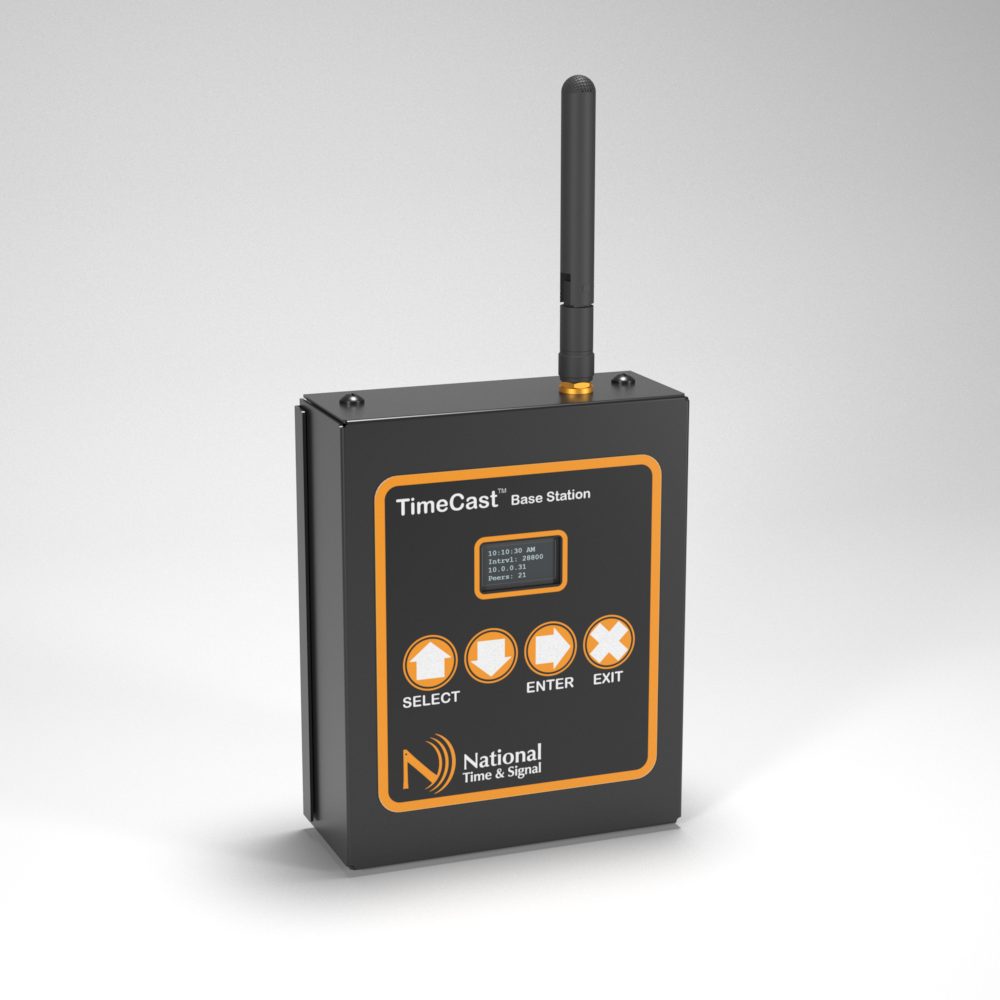
A Base Station is required for TimeCast™ clock systems operating in Radio Frequency mode. The Base Station broadcasts TimeCast™ Radio Frequency signals to nearby TimeCast™ clocks which then repeat these signals to other clocks. As each TimeCast™ clock repeats the Radio Frequency signals, the TimeCast™ data floods to all clocks in the facility within a fraction of a second. This creates a mesh network of clocks where each clock has multiple paths to receive the time data for reliable communication.
Once all the clocks receive the time data, they report check-in information back to the Base Station through the mesh network. All secondary clock information is gathered by the Base Station and stored locally or uploaded to the free National Time cloud service. On the National Time Device Cloud, a complete check-in history can be viewed for each clock, as well as information including signal strength and battery level.
The low wattage Base Station transmitter and ISM frequency bands mean that a site license is not required for installation. This Power-over-Ethernet (POE) unit is small enough to mount wherever needed. For installations without POE, the unit can be powered with a 24VDC wall transformer. The easy to understand user interface with 4-line display makes set- up a breeze. The LAN connection can use a local or internet SNTP time server to keep accurate time. A battery backup can keep internal time during outages.
 617
617